
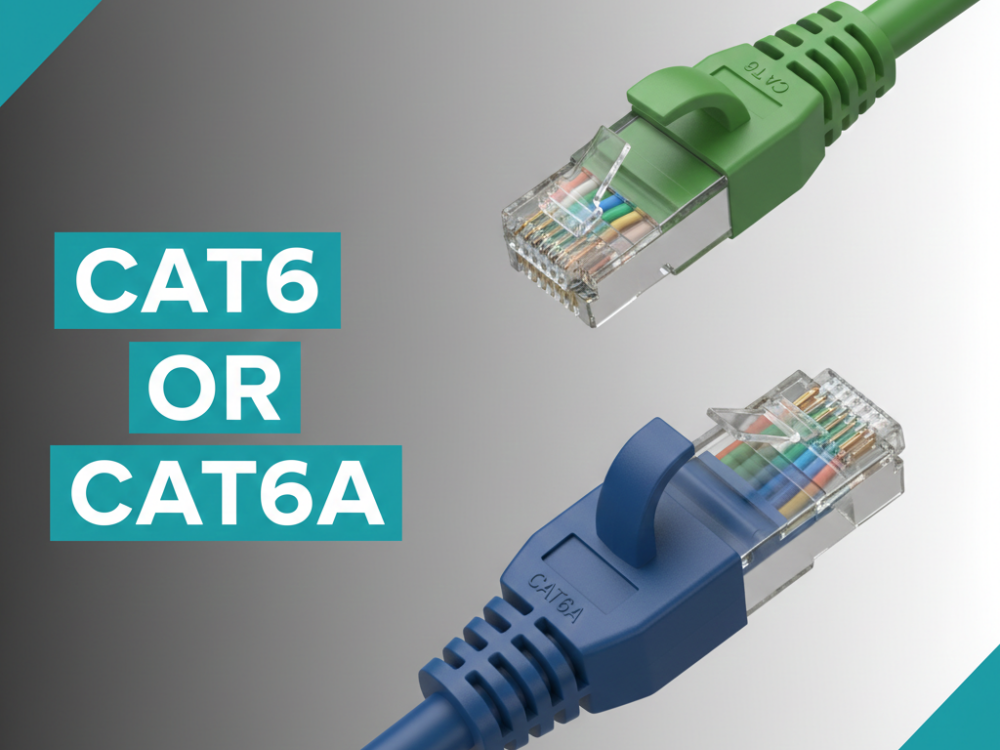
Actually, CAT6e is never existed, it’s just a marketing trick. The letter “e”, they call “Enhanced’ just a Marketing Term. So stop buying any cables called any “e-Enhanced”. With15 years of experience in ethernet cable industry, now let’s break down the real deal behind network cables, specifically focusing on CAT6 and the marketing trick “CAT6e,” and help you make smart choices for your networking needs.
The OG – What is CAT6 Cable Anyway?
Think about it: we’ve come so far. Remember the days of CAT3, then CAT5, and finally the slightly-better CAT5e cables? Then came CAT6 in the early 2000s. Suddenly, Gigabit Ethernet became a real possibility for everyday use.
CAT6 Ethernet cable was a game-changer. It essentially doubled the bandwidth compared to its predecessors. But what makes it tick under the hood? We’re talking twisted pairs, an internal spline to reduce crosstalk, and a 250 MHz bandwidth. In practical terms, that translates to 1 Gbps over 100 meters. Interestingly, it can even handle 10 Gbps over shorter distances, up to about 55 meters in ideal conditions. And, thankfully, it plays well with others – backward compatibility is a huge plus. Plus, it’s great for PoE (Power over Ethernet) devices, powering devices like IP cameras and VoIP phones directly through the cable.
In my opinion, CAT6 network cable remains the everyday hero of home and small office networking. It’s perfect for streaming your favorite shows, lag-free gaming (well, mostly!), and the ever-important work-from-home setup. It still serves as a solid backbone for connecting computers, routers, switches, and even within data centers for those shorter runs. Users appreciate its reliability, stability, and the fact that it offers excellent performance for the price. It just works.
The Mystery – Unmasking “CAT6e”
Now, for the plot twist. Here’s where things get murky, bordering on the outright misleading. “CAT6e” isn’t a real, officially recognized standard. Let that sink in.
So, what’s going on? It’s a marketing ploy, a way for some manufacturers to imply “enhanced” performance, often mirroring claims made by CAT6A, but without the official certification to back it up. You’ll see wild variations in claimed specs – 500-600 MHz bandwidth, promises of 10 Gbps over 100 meters – but there’s no consistent definition or guarantee of performance. It’s a veritable Wild West of specifications. The danger is that it’s easily mistaken for a legitimate upgrade, in the same way CAT5e was a clear improvement over CAT5.
The industry consensus is clear: stick to established standards. The “e” designation can be misleading and not worth the extra cost. There are potential pitfalls lurking. Some manufacturers might use cheaper materials, like Copper-Clad Aluminum (CCA), which can negatively impact performance and is especially problematic for PoE applications due to increased resistance and heat generation. Buyer beware, indeed.
The Real Upgrade – Enter CAT6A
When CAT6 wasn’t quite cutting it for those longer-distance 10 Gbps requirements, the industry responded with CAT6A. It’s the true successor, the legitimate upgrade we’ve been searching for. The TIA officially formalized CAT6A back in 2009.
CAT6A boasts some serious superpowers. It delivers 10 Gbps over the full 100 meters. It doubles the bandwidth of CAT6 (Category 6), reaching a blazing 500 MHz. Moreover, it’s designed to combat alien crosstalk – interference from neighboring cables – with thicker jackets, tighter twists in the wire pairs, and better shielding. It’s built like a tank: more robust, but also noticeably bulkier and, yes, pricier than CAT6.
CAT6A dominates in scenarios demanding future-proofing and high performance. It’s highly recommended for new building installations, data centers, and enterprise networks. Think about hospitals, schools, and environments needing high-bandwidth 10 Gigabit Wi-Fi, and advanced PoE applications. It’s a smart investment. The higher upfront cost ensures reliable, high performance for years to come, minimizing the need for costly upgrades down the road.
How to Choose Your Ethernet Champion
For the everyday user (1 Gbps needs): CAT6 is your reliable, cost-effective best friend.
For short 10 Gbps runs (under 55m): CAT6 might work, but CAT6A provides a much safer bet for mission-critical applications where performance is paramount.
For high speed & future-proofing (10 Gbps over 100m): CAT6A is the only way to go.
Avoid the “e” trap: Skip “CAT6e” entirely. Opt for cables adhering to officially recognized standards to guarantee performance and avoid potential headaches.
One critical point often overlooked: a fast cable isn’t a magic bullet. Proper installation practices, adhering to bend radius guidelines, and ensuring compatibility with other network components are all absolutely crucial.
| Feature | Cat6 (Category 6) | Cat6a (Category 6 Augmented) |
| Max Data Rate | 1 Gbps (up to 100m) / 10 Gbps (up to 55m) | 10 Gbps (up to 100m) |
| Bandwidth | 250 MHz | 500 MHz |
| Max Distance (10G) | 37 – 55 Meters | 100 Meters |
| Shielding | Usually Unshielded (UTP) | Usually Shielded (STP/S-FTP) |
| Cable Thickness | Thinner & More Flexible | Thicker & Stiffer |
| Alien Crosstalk | Standard protection | Enhanced protection (Augmented) |
| PoE Support | Good (Standard PoE) | Better (Ideal for High-Power PoE++) |
| Cost | More Affordable | Higher (approx. 20-30% more) |
| Best For | Home networks, small offices | Data centers, 10G networks, future-proofing |
The Road Ahead – What’s Next for Wired Networking?
The relentless march of technology continues. What does the future hold for wired networking?
We’re already seeing speculation about cables beyond CAT8 cable, potentially aiming for 100 Gbps around 2030. Fiber optic cables, of course, continue their reign in long-haul and extreme-speed applications, with 400GbE, 800GbE, and even 1.6TbE technologies already emerging. Single Pair Ethernet (SPE) is gaining traction for IoT and industrial applications where miniaturization and cost-effectiveness are key. We’re even seeing the development of smart cables with enhanced PoE capabilities (up to 100W), hybrid fiber-copper designs, and even AI-driven network optimization. And let’s not forget the growing emphasis on green networking, with energy-efficient cables and sustainable manufacturing practices.
Despite the rise of wireless technologies, wired connections aren’t going anywhere. They remain absolutely critical for reliability, security, stability, and low latency, especially in data centers, cloud computing environments, and for emerging AI applications.
Conclusion: Wiring Up Smart!
Let’s bring it all together. CAT6 Ethernet cable is a solid choice for most everyday networking needs. “CAT6e” is essentially a marketing fabrication, so avoid it. CAT6A cable is the true upgrade for 10 Gigabit applications, especially over longer distances.
We offer high-quality Cat6 and Cat6a patch cables and Lan network cables. To learn more, please visit Cat6 products page!
Ultimately, the key takeaway is this: don’t get tangled in marketing hype. Choose officially recognized standards for a network you can trust. Choose wisely, and wire up smart!